Tuesday, July 22, 2014

SLEEP

Understanding Sleep for Optimal Recovery & ProductivityTravis Cooper  |  Olympic Weightlifting  |  April 14 2014 


Image from http://www.alongside.me/human-improvement/human-improvement-mind/triphasic-sleep/ - Olympic Weightlifting, strength, conditioning, fitness, nutrition - Catalyst Athletics


Sleep is the most important part of recovery when it comes to illness, depression, stress and especially training. In regards to weightlifting, without quality sleep, weightlifters cannot properly recover and reach their full potential. There seems to be a lot of misconceptions about sleep and sleep cycles, so hopefully this article will clarify a few things so you will be able to get the most out of your sleep, which will result in optimal training.

As seen in the included graph, there are several different stages of sleep: Stages 1, 2, 3, 4, and REM. Most people seem to think that a typical sleep cycle consists of only one cycle through the stages. As you can see in the image above, the stages of sleep actually cycle throughout the night depending on the duration of asleep. 

When you initially go to sleep, you soon dip into stage 1. Over the next hour, the body will go into deeper sleep until it reaches stage 4. As stage 4 ends, you will transition out of the deepest part of sleep and reverse back into the lighter stages until you hit REM. REM occurs about 2 hours after initially falling asleep. Some people think that REM sleep is the deepest period of sleep, but as you can see in the diagram, stage 4 is actually the deepest period of sleep and REM is the closest to being awake the body will be in the sleep cycle. While REM is where most of your dreaming takes place, it is actually the period of sleep where you are closest to being awake.

The body typically goes into stage 4 only two times in a full 8-hour sleep cycle. After two full cycles of stage 1-REM sleep, the body will cut out stage 4. After three cycles, the body will cut out stage 3. The body will continue to go through two cycles of stage 2 and REM before you awake naturally.

If you are not getting 8 hours of sleep per night, you are not completing the cycles of sleep and thus not optimizing your recovery. It is impossible to overcome sleep deprivation through any other recovery method. If something helps, the results are merely temporary. In an ideal world, 8 hours of sleep would be a regular occurrence and there would be no need for sleep studies and articles because everyone would be getting enough rest for recovery. In a fast-paced world filled with work, family and other obligations, sleep isn’t always a priority. 

Most weightlifters in this country have things other than weightlifting in their lives, such as careers and families to support. They may work a typical 8am-5pm job, participate in family activities, and eventually train in the remaining hours left in the day. In most cases like this, a person is very unlikely to get in a full sleep cycle of 8 hours. 

There are some things to take into consideration if you absolutely cannot get a full 8 hours of sleep per night. Often times we set our alarms to go off at the last possible moment so that we can wake up and still make it to work on time. It makes sense to us to do this. More sleep = better sleep, right? 5 hours and 35 minutes must be better than 5 hours and 5 minutes. In actuality, quantity of sleep may not be optimal for your sleep cycle and productivity if you are getting less than the full 8 recommended hours.

The least optimal period of sleep to wake up during is stage 4. Stage 4 is the deepest period of sleep and if you wake up out of stage 4, you are likely to be disoriented, groggy, and even have a headache. An example might be on a night where your house alarm goes off and you wake up out of a deep sleep with a headache and it takes a few minutes to figure out where you are and what’s happening. The pattern follows from least to most optimal to wake up is stage 4, 3, 2, 1, REM (stage 1 and REM being the most ideal stages during which to wake up). The deeper the period of sleep you are in when your alarm goes off, the more groggy, disoriented and less productive you will be that day.

When you wake up out of deep periods of sleep continuously, you are subconsciously telling your body that you no longer need deep periods of sleep. Sleep disorders are likely to occur because of this. If you are regularly able to wake up during the lighter periods of sleep, productivity is higher and you will find yourself much more alert and feeling well-rested throughout the day. 

For instance, if you only had 5 total hours to sleep, it would be more ideal to wake up at the end of the REM cycle which should occur at only 4 hours 15 minutes than to wake up at any point between 4 hours 15 minutes and 5 hours since your body will be in a deeper stage of sleep in that final 45 minutes. Another thing to realize is that the first 4 hours of sleep is where most of the deep sleep happens. As the sleep cycle continues, you will spend less time in deeper periods of sleep and more time in REM sleep. 

So, of what use is this information? This is a weightlifting website and this is an article about sleeping. My suggestion is that if you know you will not be getting a full 8 hours of sleep, you should utilize the sleep stage chart and set your alarm for a time that gives you a good chance to wake up in a lighter period of sleep, even if that means you will get less total sleep. You will find that you will feel more refreshed and be more productive. Training (and other aspects of your life) will go better if you wake up in the proper part of your sleep cycle.

Products are continuously being developed regarding this subject. Eventually, you will be able to purchase a product that allows you to set a time interval and it will know when during that time interval is most optimal to wake you up. These are called smart alarms or sleep cycle alarms. Until then, you have the most control over your sleep intervals. A simple sleep chart and proper planning may make the difference in how you train and recover to the best of your ability. Give it a try and the results may surprise you. 

Sleep well, eat well, and train hard!

Tuesday, July 15, 2014

Lumbar Lordosis: Stop sticking your butt out.


Invictus CrossFit posted this article on their Blog and I think I see this fault every day in the gym.Lumbar Lordosis: Stop Sticking Your Butt Out!

Written by Zach Erick
Lumbar Lordosis by Zach Erick of CrossFit Invictus San Diego
What is the Lumbar Lordosis? No, it is not the name of a character on Game of Thrones. It is actually a very common problem many clients may not realize they have.
This post hits home with me. Years of sleeping on my stomach and not activating my glutes have given me lumbar lordosis. What is lumbar lordosis? It is defined as “a condition in which the spine in the lower back has an excessive curvature.” If you know what to look for, it is easy to spot. Take your shirt off and look at a profile view of yourself in the mirror. If your butt is sticking out, along with your stomach, you’ve got it.
Lumbar Lordosis with a CrossFit athlete is most likely caused by a lack of glute recruitment while using the posterior chain. Think of a deadlift or back squat, for example. If you are not squeezing the glutes as the hips come to extension, you are missing out on a untapped power source – the booty! Years of deadlifting (or lifting anything from the ground), without contracting the glutes, will cause the spinal erectors to over develop (chronically shortening them), pulling the hips from underneath the body, making you look like you are sticking your butt and belly out.
How do we fix this? Luckily, the cures for Lumbar Lordosis are simple: Awareness and Exercise. Here are a few simple tests from Kelly Starrett’s “Becoming a Supple Leopard” to help you become aware of the positions you need to walk, stand, lift, and sit in, along with exercises to strengthen those buns! 
  • Bracing Sequence
  • Side Front
  • Monster Walks
  • Banded Squats
  • Clam Shells
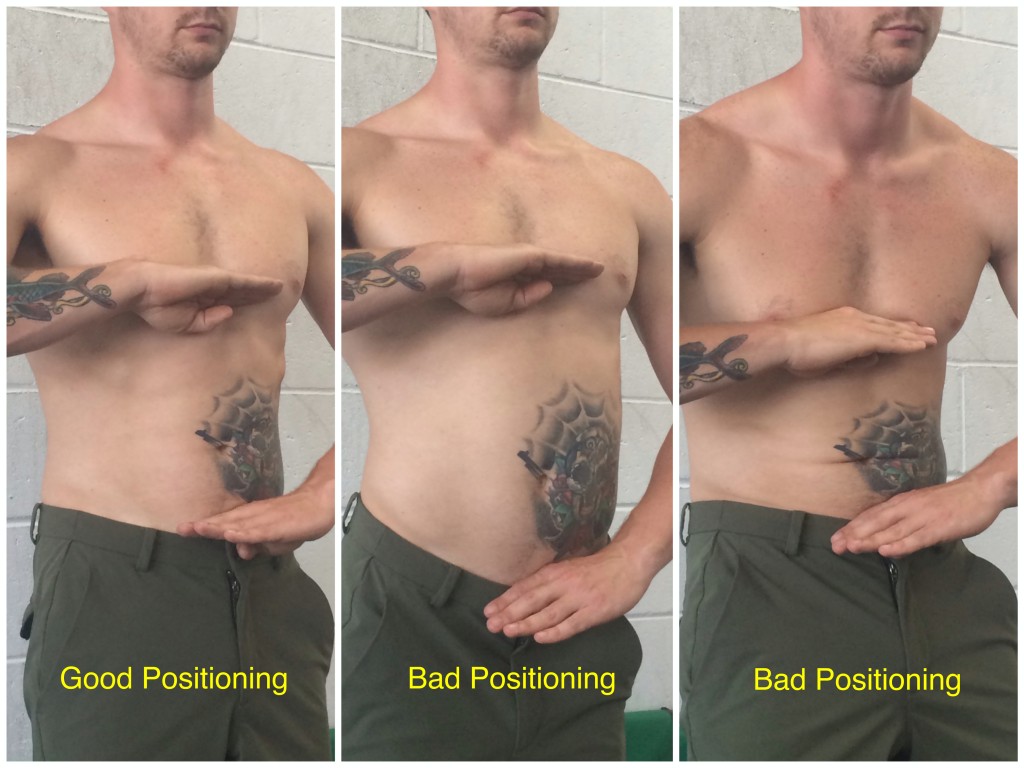
  • The Two-Hand Rule: This technique can be found on page 31 in Kelly Starrett’s book, “Becoming a Supple Leopard.” Place one thumb in the center of your chest and the other thumb on your pubic bone. When you squeeze your abs and butt the hands will create two parallel lines. If you are either over-extended or stuck in flexion the hands will not be parallel to one another.
Awareness is only half the battle though! Glute recruitment is extremely important to aid in fixing this problem. Remember, to always go through the bracing sequence before lifting. Not only will this set you up in a stronger position, it will also prevent injury.


LumbarCollage_Fotor

A basic guide of what I eat.. and some thoughts.

Guide Meal Plan

-          Keep in mind that this is just a guide filled in with examples of what I eat. Just by looking at it you can basically get the idea and fill in some of your favorite foods and replace mine except when it comes to the carbs… because there aren’t many substitutes I approve of. 

The idea is to stay away from carbs in the morning and preferably work out at this time. Small amount for lunch and then a “carb load” dinner.

-          Stay away from anything with ingredients you can’t pronounce and processed foods. The idea is to eat whole healthy foods.


You will need to play around with portions because I can’t really prescribe anything without knowing your schedule, activity during the day, and even how your body reacts to certain foods. So play with portions until you find a nice medium. Keep in mind that as a society we eat entirely too much. So start smaller and add in more if you feel depleted during the day.

Water intake needs to be at least over 100 ounces per day. I don’t care if it’s a guy that weighs 500 pounds or a girl that weighs 70 pounds.

Awesome juicer to throw into any meal: Two handfuls of spinach, pinch of honey, lemon juice, and either a couple raspberries/strawberries. Fill it up with water blend and enjoy!


Ex of what I eat

Breakfast-  (cooked with coconut oil)
-          4 Eggs cooked in with a handful of ground turkey. ( can replace ground turkey with basically any protein source .. bacon, ground pork, ground steak, chicken, steak, fish… anything)
-          Half an avocado and a handful or plain almonds.  (for healthy fat intake)
-          If you drink coffee no sugar or creamer, but rather put in a slice of butter. (don’t ask. It just works)
-          Optional smoothie/ juice you can throw into any meal is simply: two handfuls of spinach, some raspberries or strawberries, pinch of honey, lemon juice, and water. Just blend it up and enjoy!

Lunch
                Rarely I will have a sandwich with avocado and cheese. When I do I just use one piece of bread so it’s kind of just an open sandwich.
                Normally I will have some source of protein: Meat, fish, chicken
Carbs: Sweet Potato, wild grain rice or brown rice, black beans, Quinoa
VEGETABLES: super important. Eat as many as you can. I just go raw and eat broccoli, cauliflower, and carrots. You can get as fancy as you desire. I usually just keep it simple and eat as many as I can.
 There is no such thing as eating too many vegetables.
For weight loss staying away from dairy can be beneficial. I usually drink a glass of milk each meal and love cottage cheese, but my goal is to gain weight so keep this in mind.


Dinner:

Simply repeat lunch, but feel free to add in a larger portion under the Carbs category.

·         Keep fruit intake low. Maybe a banana or apple a day added in to your lunch or breakfast, too many times my clients think fruit is great to splurge on and eat all the time. While it has it’s health benefits let us keep in mind an apple has the same amount of sugar as a snickers bar. Sugar is sugar. Period.

Again this is a very specific example of what I eat, but feel free to add in foods you enjoy. Just shoot me a message if you have any questions.

If you can send me a list of the free weights you guys have I can send you programming.

Are there rowers, kettle bells, pull up bars, squat racks…..


Good luck! And again just think whole healthy foods and don’t feel bad about cheating… Just try to keep it 80/20